
Operational Reliability & Food Safety

Operational Reliability,
Supported by Tiered ABCD Maintenance.

A proposed service framework combining temperature telemetry, hardware monitoring, and clearly allocated Tier A through Tier D responsibilities.
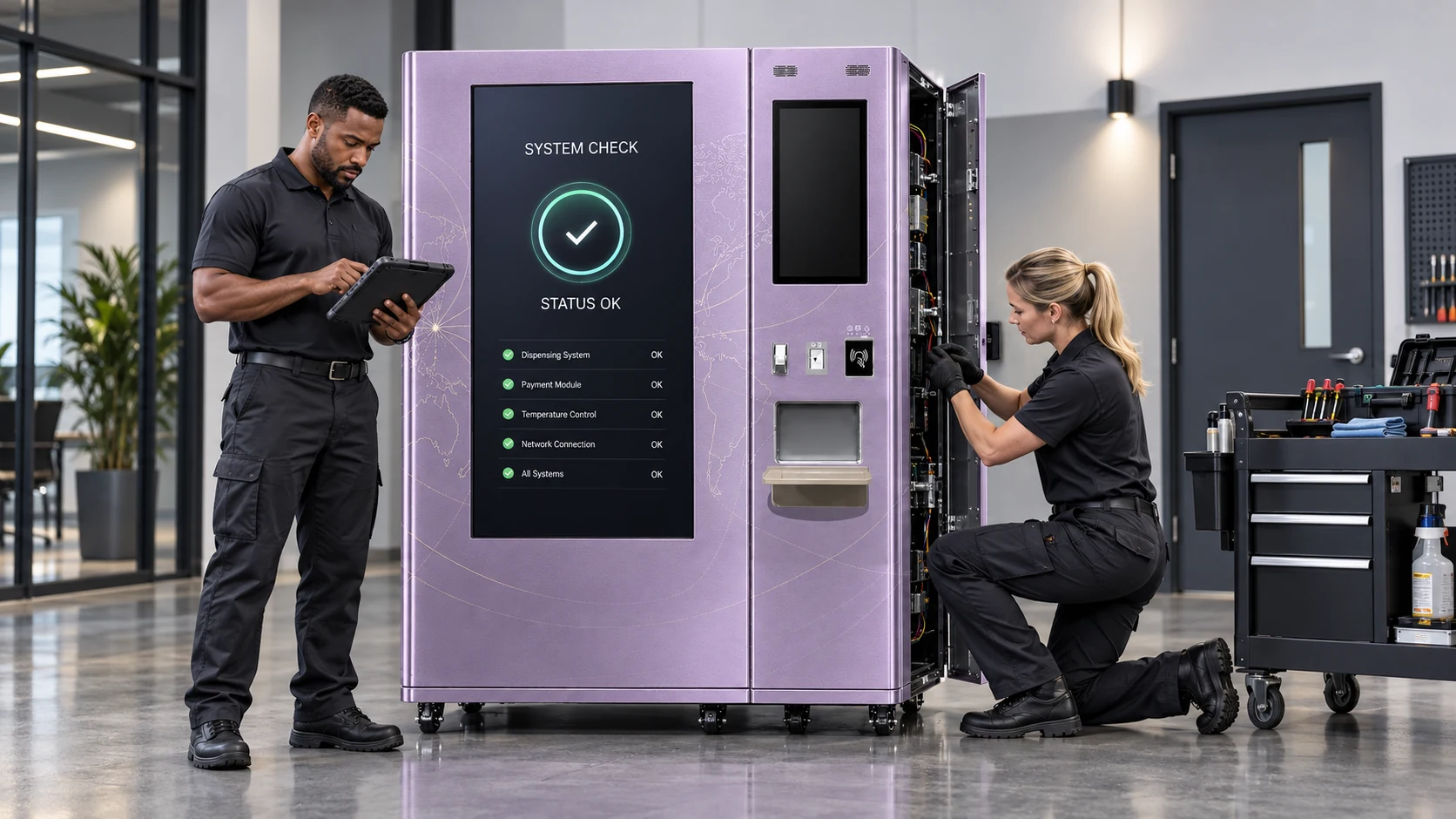
Two U.S. field service technicians performing diagnostics and maintenance on an SVM hot food station
Maintenance Protocols

Clear Roles, Predictable Execution.

The final agreement must assign each task to facility staff, route personnel, field technicians, or depot engineering.

A
Tier A • Daily Surface & Hygiene Care

Touchpoint Sanitization & Visual Sweeps

Chassis, hatch, display, and surrounding floor checks.

Managed ModelProposed route-team scope
Self-Managed ModelTrained facility custodial scope
B
Tier B • Replenishment & Stock Optimization

Inventory Rotation & Cold-Chain Audits

Restocking, dates, barcode checks, and seal inspection.

Primary ScopeAuthorized logistics personnel
TriggerScheduled route or reviewed stock alert
C
Tier C • Scheduled Technical Service

Modular Maintenance & Sensor Calibration

Condenser, servo, chamber, sensor, and transfer-mechanism care.

Primary ScopeQualified field technician
TimingPlanned non-peak service window
D
Tier D • Depot Repair & Unit Exchange

Core Replacement & Lifecycle Overhaul

Compressor, control board, insulation, or unit-level work.

Primary ScopeEngineering depot or approved partner
Commercial TermsDefined in the signed SLA
Responsibility Matrix

Facility Host vs. Service Provider.

Facility Host Responsibilities
  • Approved, stable dedicated power
  • Clear accessible pathways and service space
  • Timely security access for authorized visits
  • External trash and recycling management
Service Provider Responsibilities
  • Telemetry scope defined by service plan
  • Inventory and route planning where contracted
  • Documented shelf-life and temperature controls
  • Tier C / D labor and parts as contracted
CLOUD CONTROL CENTER CONCEPTTemperature, inventory, door cycles, and service flags.

Illustrative interface only. Metric availability and alert logic remain subject to product validation.

Predictive Telemetry

Smart Hardware Designed to Surface Issues Early.

Proposed cellular telemetry can transmit operating metrics without joining a client production network, subject to security and connectivity review.

  • Thermal Logging: Validate sensor accuracy, retention, and compliance requirements.
  • Expiry Controls: Confirm SKU data and lockout behavior in approved specifications.
  • Mechanical Alerts: Define supported health signals and escalation thresholds.
  • IT Coordination: Review the final network architecture with facility stakeholders.
Service Rhythm

Three Core Service Rhythms

Continuous visibility, scheduled preventive care, and tiered field response keep responsibilities clear from daily operation through technical recovery.

24/7AIoT Telemetry Monitoring
RoutineScheduled Preventive Inspections
3–7 DaysService & Maintenance Target
Service-target notice: Monitoring scope, inspection frequency, service clock, regional coverage, parts availability, site access, arrival, and resolution definitions must be confirmed in the signed U.S. service agreement.

Define uptime responsibilities
before the station goes live.

Review proposed service levels, escalation paths, and commercial maintenance terms.

Discuss Operational SLAs →